Fire-panel battery sizing is one of the few backup calculations that has been formalised into a normative method, and it rewards careful bookkeeping. Paper B follows that method - the Annex E battery calculation introduced in current BS 5839-1 practice and consistent with EN 54-4 - from the itemised quiescent and alarm loads, through the derating for efficiency, depth of discharge and end-of-life fade, to a nameplate ampere-hour figure; it then compares the candidate chemistries on life-safety axes and sets out the 24 V pack, supervision and float-charger design that makes the calculated capacity real for a decade.
The calculation begins with two separate load tables. The quiescent table lists the panel itself and every supervised device - loop-powered detectors, monitor and control modules, annunciators, communicators - at their standby current, summed to a single quiescent figure in amps. The alarm table lists everything energised in the fire state: sounders and horns, beacons and strobes (using the strobe's averaged or synchronised current as appropriate), voice-alarm channels and fire-service or suppression interfaces, summed to an alarm current. Modern addressable devices publish standby and alarm currents precisely, and a panel with hundreds of loop devices can reach a quiescent current that surprises designers accustomed to small conventional panels.
Keeping the two tables separate is essential because they are multiplied by different durations - the quiescent current by 24 or 72 hours, the alarm current by 0.5 hour - before being added. Merging them into a single 'average' is the most common route to an undersized life-safety battery.
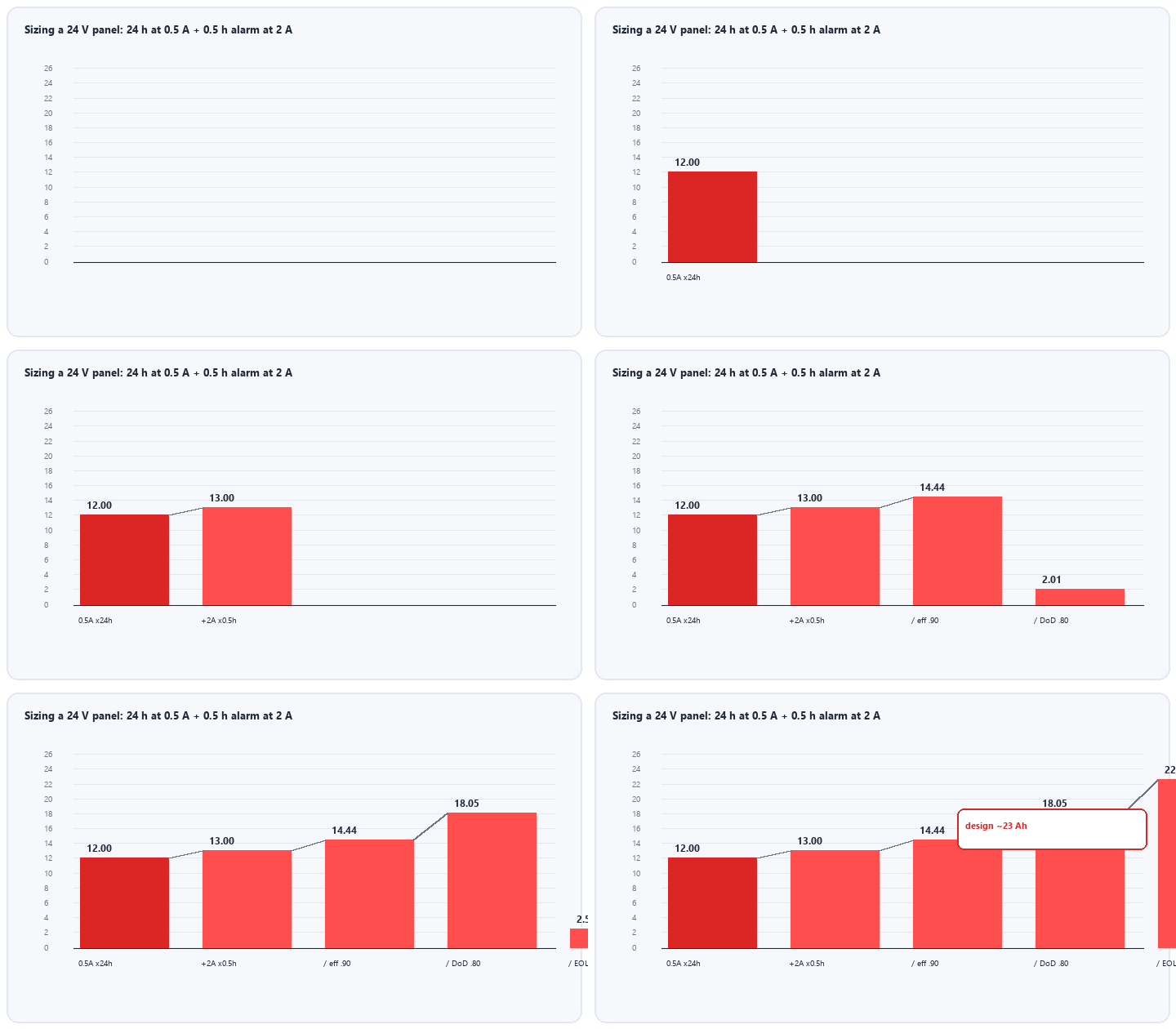
The animated waterfall works a representative 24 V panel: 0.5 A quiescent for 24 hours is 12 Ah, and 2 A in alarm for half an hour adds 1 Ah, a raw demand of 13 Ah. Dividing by conversion efficiency near 0.90, limiting usable depth of discharge to about 0.80 to avoid leaving a life-safety pack deeply depleted, and reserving an end-of-life factor near 0.80 for years of float fade brings the nameplate requirement to roughly 23 Ah. The BS 5839-1 Annex E method formalises precisely this structure - quiescent energy plus alarm energy, adjusted by the factors the standard and the manufacturer's cell data dictate - and the current edition clarifies the calculation so designers no longer rely on rules of thumb.
The 72-hour unmanned scenario scales the quiescent term threefold and therefore dominates the result, which is why the standby scenario - whether mains loss is monitored by an alarm-receiving centre - must be settled before the battery is chosen rather than discovered at commissioning.
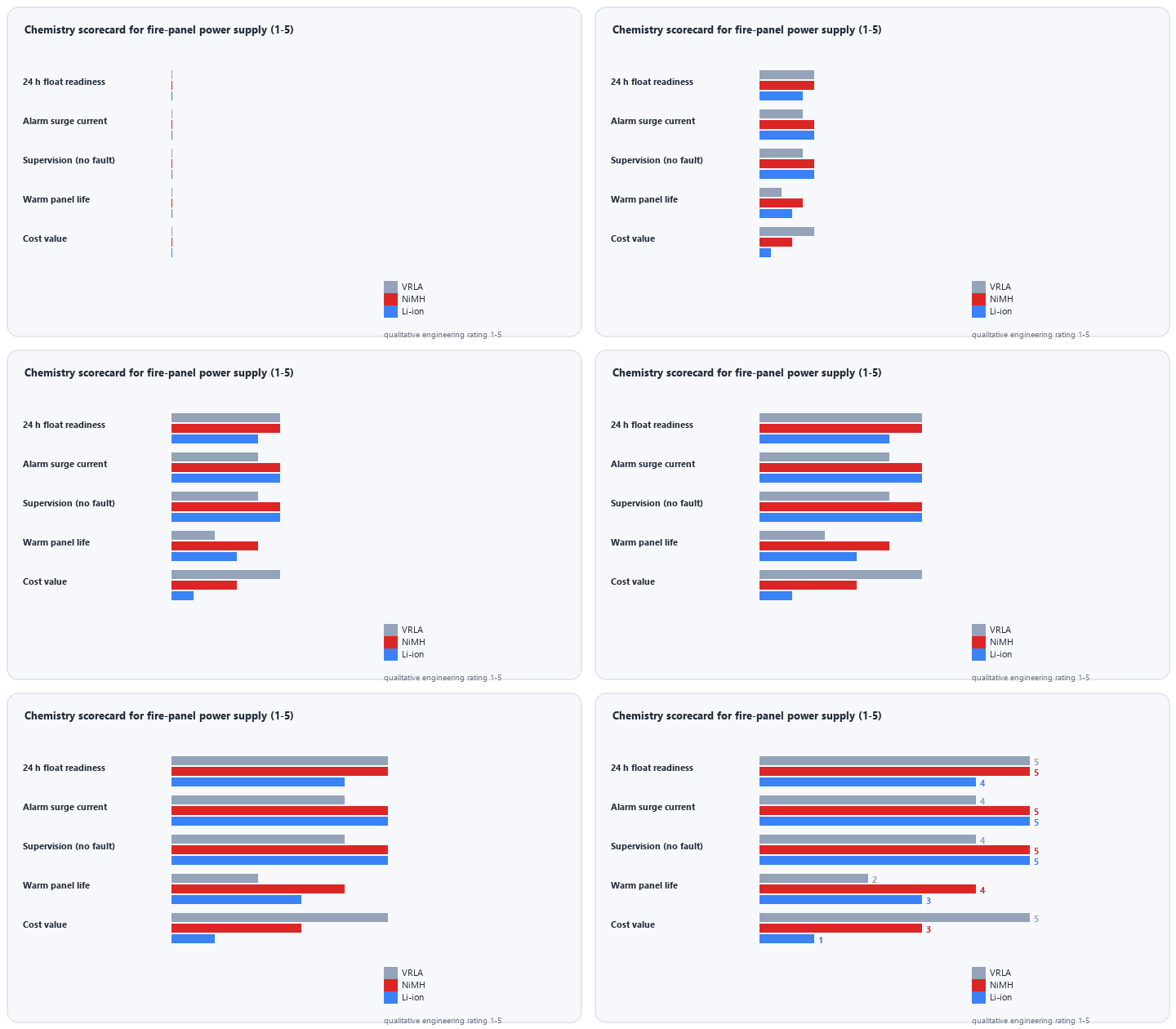
The animated scorecard rates sealed lead-acid, NiMH and lithium on five axes specific to a fire panel: 24-hour float readiness, alarm-surge current, supervision compatibility, warm-panel life and cost value. Lead-acid is inexpensive and familiar but sulphates under perpetual float, weakens in the cold and is heavy. Lithium is compact but requires protection and balancing and carries transport and ageing considerations in a device expected to last the building's fire-system service interval. NiMH rates strongly on readiness and surge, offers a predictable plateau that supervision thresholds can track, and outperforms lead-acid in cold plant rooms, with the simplest shipping for spares.
The honest position is that NiMH competes most strongly where cold performance, weight, cycle behaviour after repeated outages and cadmium-free materials matter, and where the designer is prepared to implement the temperature-aware float that aqueous nickel requires - a known, manageable discipline rather than a research problem.
Twenty series cells build the nominal 24 V rail, with a charged string near 27-28 V tracking the legacy lead-acid charge envelope closely enough to reuse much of the PSE architecture. Cell format is driven by the alarm current: C and sub-C cells provide the electrode area and internal resistance to hold the rail through the full notification load and strobe inrush, while smaller formats suit compact panels with few appliances. Matched-lot cells sorted for capacity and impedance, welded nickel tabs, an insulating carrier and integrated PTC or thermal fuse give a pack that survives installation vibration and a decade in a metal enclosure.
The pack should present a defined, replaceable form factor with clear polarity and keyed connectors, and a capacity label stating the quiescent/alarm scenario it supports - mirroring the way two-series lead-acid blocks are swapped during servicing, but in a single balanced NiMH string that cannot develop the cross-block imbalance of two separately aged 12 V batteries.
EN 54-2 and EN 54-4 require the PSE to supervise the battery and signal a fault on loss, disconnection or degradation without impairing the alarm function. The monitor typically tracks terminal voltage, charge current and an internal-resistance or load test. NiMH's flat plateau and defined end knee make voltage-based supervision predictable across most of the discharge, with a clean drop near exhaustion; combining that with a periodic internal-resistance check - which rises as the pack ages - gives early warning of a pack approaching end of life before it can fail a real outage.
Designing the thresholds around the NiMH curve (rather than copying lead-acid voltage trip points) avoids both nuisance faults mid-life and missed warnings at end of life, and the low-impedance pack ensures the monitor's load test does not itself sag the rail.
The charger is decisive because it runs continuously. It must meet EN 54-4's recovery windows - 80 percent within 24 hours, full within a further 48 - while never overcharging during the years of readiness that follow. For NiMH that means a controlled charge to full, then a temperature-aware maintenance regime at or below C/20 (or a pulsed/compensated float), with thermistor cut-back as the panel enclosure warms, since sustained charging above roughly 45 degrees C drives gas evolution and dry-out. The charger must also transfer to battery without a dip when mains fails and accept the returning mains without raising a spurious fault.
Pairing that disciplined PSE with a derated, matched NiMH pack is what allows the Annex E calculation to remain valid at the end of the service interval - the subject the certification evidence in Paper C makes auditable.
Weijiang Power builds 24 V NiMH fire-panel packs to the BS 5839-1 Annex E method: matched welded C/sub-C strings sized from separate quiescent and alarm load tables with full efficiency, depth-of-discharge and end-of-life derating, predictable-plateau cells for clean supervision, thermistor-ready float designs and IEC 61951-2, IEC 62133-1 and UN 38.3 documentation. Send your two load tables and standby scenario for a calculated, auditable pack size.


