
Sizing a remote monitoring terminal means reconciling a multi-year average-current budget with a seconds-long worst-case event burst, and deciding whether a sealed primary battery or a solar-rechargeable buffer is the right architecture. This paper works through the method: the chemistry comparison, the state-by-state energy budget, the event-burst pulse sizing, the solar-plus-NiMH design for high-frequency terminals, and the cold and ingress considerations that decide field reliability.
The animated scorecard rates primary Li-SOCl2, a solar-charged NiMH buffer, a supercapacitor and rechargeable Li-ion on long-term energy, event-burst current, solar charge acceptance, cold discharge, sealed-enclosure safety and cost. Primary lithium wins where there is no light and the load is gentle; the supercapacitor handles pulses but holds little energy and is poor as a multi-day solar reserve; rechargeable Li-ion stores energy but needs a BMS and brings thermal questions to an unattended IP68 enclosure; the NiMH buffer accepts irregular solar charge, pulses strongly, cycles daily for years and is intrinsically aqueous and safe.
The two defensible architectures are therefore a primary-lithium-plus-pulse-reservoir design for dark buried sites, and a small solar panel with a NiMH buffer for accessible or above-ground sites that need frequent sampling.

Sum charge per day across every state: sleep current for almost 24 hours, transducer excitation current times excitation-stabilisation time times samples per day, MCU processing per sample, and radio attach-plus-transmit current times time times reports per day (including retries in poor coverage). Convert to an equivalent continuous current and add self-discharge and an end-of-life margin.
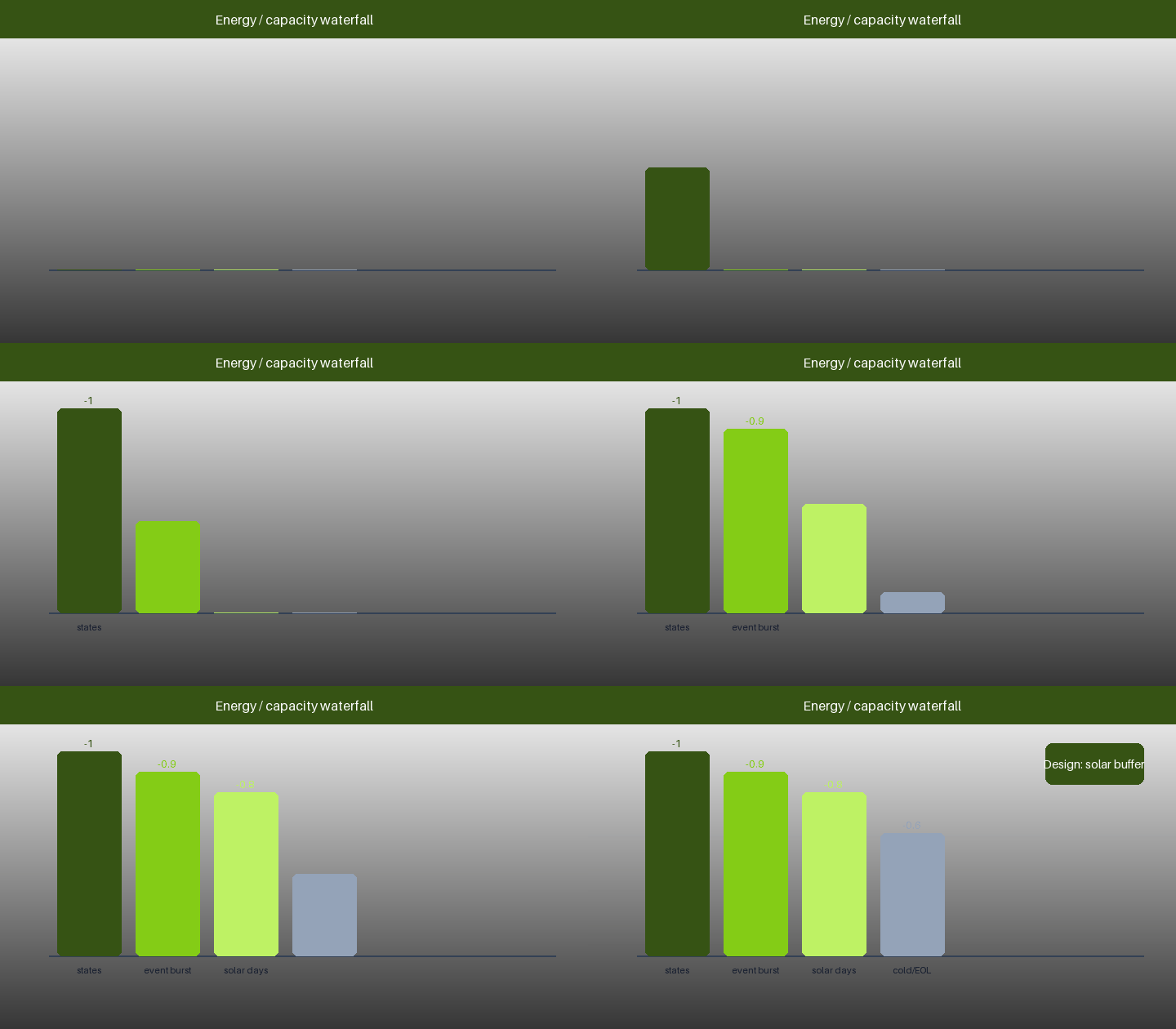
The second animated figure is the energy waterfall: the sleep floor, the transducer excitation that grows with sampling rate, the routine radio contribution, the event-alarm allowance, self-discharge and the end-of-life/cold derating, ending at the required capacity. Making the excitation term explicit matters - designers often forget that powering the sensor for a second dominates over the microsecond ADC reading.
The worst case is a transient alarm: rapid sampling for several seconds while the radio attaches and sends an unscheduled frame. Size the pack (or reservoir) for that combined peak at the lowest temperature and at end of life, and require the voltage to stay above both the MCU brown-out and the radio minimum throughout. Welded tabs and low-resistance cells are essential; this is where a high-impedance primary cell or an undersized reservoir fails.
NiMH's flat plateau and pulse current cover the combined sampling-plus-transmit burst in a compact pack, with margin for an immediate alarm retry if the network does not acknowledge.
For a solar-assisted terminal, size the panel to refill the daily load - plus charging losses and several days of autonomy for overcast weather - using realistic effective sun hours at the site rather than peak irradiance, and size the NiMH buffer to carry the load through the autonomy period while accepting the panel's charge. A charge manager terminates or tapers charging near 45 C and prevents overcharge, and the pack is sized to a moderate routine depth of discharge to protect its multi-year daily cycle life.
Low-self-discharge NiMH is forgiving of the resulting partial, irregular charge pattern and holds its reserve through cloudy stretches - an advantage over chemistries that demand precise charge management in a low-cost sealed terminal.
Field terminals run from -30 C in winter to +70 C in a sun-exposed enclosure. NiMH discharges reliably in the cold (though capacity is reduced and must be derated), while its charging is limited near freezing and cut back in heat - rules the charge manager enforces. For maintainable sites, a replaceable AA/Sub-C NiMH or lithium pack in a sealed carrier lets field crews swap power without opening the instrument electronics, preserving the IP66/IP68 seal.
Welded cells, a fuse, an NTC, conformal coating and a vent-friendly layout complete a pack that survives condensation, vibration and a decade of thermal cycling in the field.
Record the sampling and reporting assumptions, the event-burst definition, the solar autonomy days, the temperature derating and the ingress approach. In a permanently dark, low-frequency site a primary lithium pack with a small pulse reservoir remains correct; in any accessible, higher-frequency or solar-viable site, a rechargeable NiMH buffer usually wins on lifetime and data density. Paper C validates the design against ingress, EMC and the cell evidence.
Weijiang Power builds sealed nickel-metal hydride cells and solar-compatible buffer packs for NB-IoT and LoRa pressure and flow monitoring terminals. Share your transducer excitation current, sampling and reporting interval, radio profile, solar-panel size and temperature range, and our engineers will design a welded, cold-capable NiMH buffer or replaceable pack with charge management and protection. See formats on the products page.


