Every charging decision a NiMH charger makes - when to push current, how hard, and when to stop - is ultimately a response to electrochemistry happening inside a sealed steel can. To charge a nickel-metal hydride cell well, an engineer must first be able to write the two half-reactions that current is driving. During charge the nickel positive moves protons out of its layered lattice, converting nickel hydroxide, Ni(OH)2, into nickel oxyhydroxide, NiOOH, while the metal-hydride negative splits water to release hydrogen that is absorbed and stored as a hydride, MH. This paper opens a fifty-part research series on NiMH charging by building that reaction picture precisely, then showing how the deliberate capacity imbalance between the two electrodes is the design feature that lets a sealed cell tolerate the inevitable moment when charge current exceeds the cell's ability to store it.
The nickel positive is a porous, conductive network loaded with active nickel hydroxide. On charge, Ni(OH)2 loses an electron and a proton to become NiOOH in a solid-state, proton-rocking reaction that proceeds through the alpha/beta and beta/gamma phase families familiar from nickel-electrode literature. Because the reaction moves protons within the solid rather than plating metal from solution, its rate is governed by proton diffusion through the oxide and by the electronic and ionic conductivity of the porous electrode - both of which change with state of charge and temperature.
Near the top of charge the positive runs out of Ni(OH)2 that can be oxidised usefully. Beyond that point the same current has nowhere productive to go and begins to oxidise hydroxide ions in the electrolyte to evolve oxygen, 4 OH- to O2 plus 2 H2O plus 4 electrons. Instrumented traction-cell studies show oxygen evolution accelerating markedly past roughly 70 percent state of charge, which is the first measurable sign that a charger is entering the sensitive end-of-charge region.
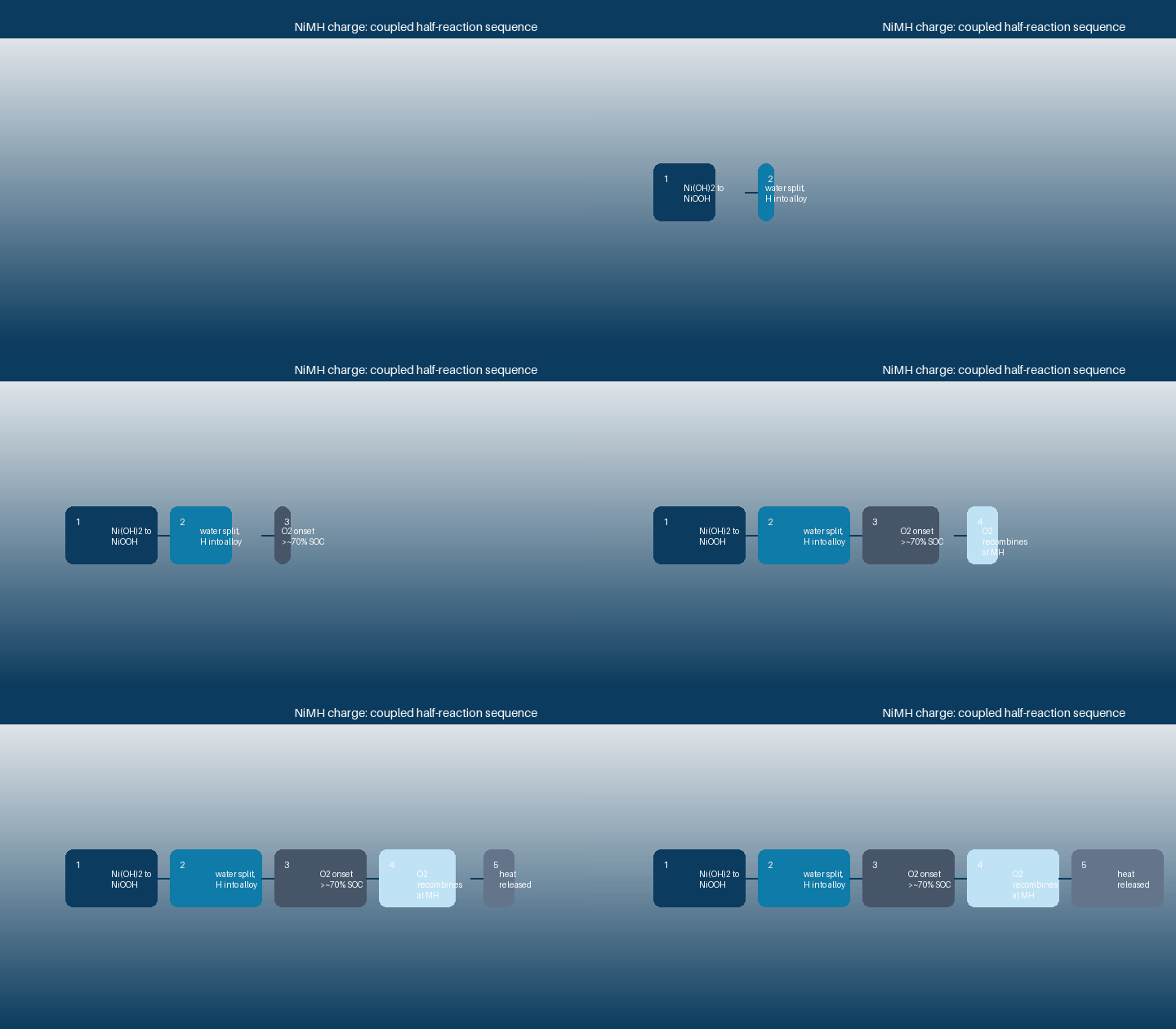
The negative electrode is a compacted hydrogen-storage alloy, most commonly a misch-metal AB5 type or a higher-capacity AB2 Laves phase. On charge it reduces water to atomic hydrogen that enters interstitial sites in the alloy lattice to form the metal hydride MH, releasing hydroxide. The alloy's plateau pressure, enthalpy of hydride formation and surface catalytic layer determine how readily hydrogen is absorbed and, crucially, how much current it can accept before molecular hydrogen is released instead.
Sealed NiMH cells are deliberately built with a negative electrode whose effective capacity exceeds the positive - a 'charge reserve' of typically tens of percent. Because the positive reaches full charge first, the negative still has empty hydride sites available when oxygen begins to appear, and it never reaches the point of evolving hydrogen in normal operation. This imbalance is the single most important structural reason a sealed NiMH cell can be overcharged without immediately producing a dangerous mixture of gases.
When oxygen is generated at an overcharging positive, it diffuses across the porous, electrolyte-starved separator to the oversized negative, where it is chemically reduced, recombining with stored hydrogen to regenerate water and release heat. The net result of generating oxygen at one electrode and consuming it at the other is zero net chemical change - but all of the input electrical energy is liberated as heat. The cell is therefore a chemical short-circuit that converts overcharge current directly into warmth and internal pressure cycling.
Recombination has a finite transport-limited rate set by separator wettability, oxygen diffusion distance, negative surface catalysis and temperature. Below that rate the loop keeps internal pressure in a manageable steady state; above it oxygen accumulates faster than it can be consumed, pressure climbs, and the safety vent may eventually open. Charge-current design is, at bottom, the art of staying within the recombination capacity of the specific cell being charged.
NiMH cells use a concentrated potassium-hydroxide electrolyte, sometimes with lithium and sodium hydroxides, but only a carefully limited volume: a 'starved-electrolyte' design that leaves gas pathways open through the separator so oxygen can reach the negative. A flooded cell would block those pathways and lose the recombination ability, while an under-filled cell suffers high internal resistance and dry-out over life. The hydrophilic separator therefore has the contradictory jobs of conducting hydroxide ions and transmitting oxygen gas.
This coupling explains why charge protocol and cell construction cannot be specified independently. A current profile that a thin, well-catalysed electrode recombines comfortably may overwhelm a thicker high-capacity design, and the same cell recombines faster warm than cold - a fact that cuts both ways, since warmth also accelerates degradation.

The cell's terminal voltage during charge is the sum of the two equilibrium potentials, the kinetic overpotentials of both reactions and the ohmic drop through electrolyte, separator and current collectors. Early in charge voltage climbs as the nickel electrode passes through its oxidation states and the hydride electrode traverses its pressure plateau; late in charge the rising oxygen-evolution overpotential and self-heating push voltage through a peak, after which heating lowers the electrode potentials and voltage falls - the negative-delta-V signature examined in detail in Paper 5.
Reading a charge curve as a superposition of reaction overpotentials, rather than as an arbitrary shape, tells a designer why a cold cell peaks higher, why an aged cell with higher internal resistance peaks earlier, and why a current too small to drive visible oxygen evolution also produces no reliable peak.
The reaction picture sets concrete requirements: match the negative charge reserve to the intended overcharge exposure, choose a separator whose oxygen transmission matches the maximum recombination current the application demands, and size the charge current so that, in the end-of-charge band above roughly 70 percent state of charge, oxygen generation does not outrun recombination. It also motivates every termination method in the series - voltage inflection, temperature rise, pressure and timers - as different observable proxies for the same underlying transition from storage to recombination.
For a manufacturer supplying cells into charger-equipped products, documenting the state-of-charge at which oxygen onset occurs, the recombination-limited current and the resulting thermal behaviour at 0.5C and 1C is what allows a customer to choose a charge profile that reaches full capacity without repeatedly driving the cell through the heat-generating recombination region. The next paper quantifies how charge acceptance and coulombic efficiency evolve across that same state-of-charge axis.
Weijiang Power designs and manufactures nickel-metal hydride cells, matched packs and charging-ready configurations for consumer, industrial, medical and mobility customers, and supports partners with charge-protocol guidance, IEC 61951-2 performance files, IEC 62133-1 safety evidence and charger co-validation. Share your cell format, charge rate, thermal envelope and cycle target and our engineers will specify a cell-and-charge combination that protects both runtime and service life. Review the range on the products page.


